
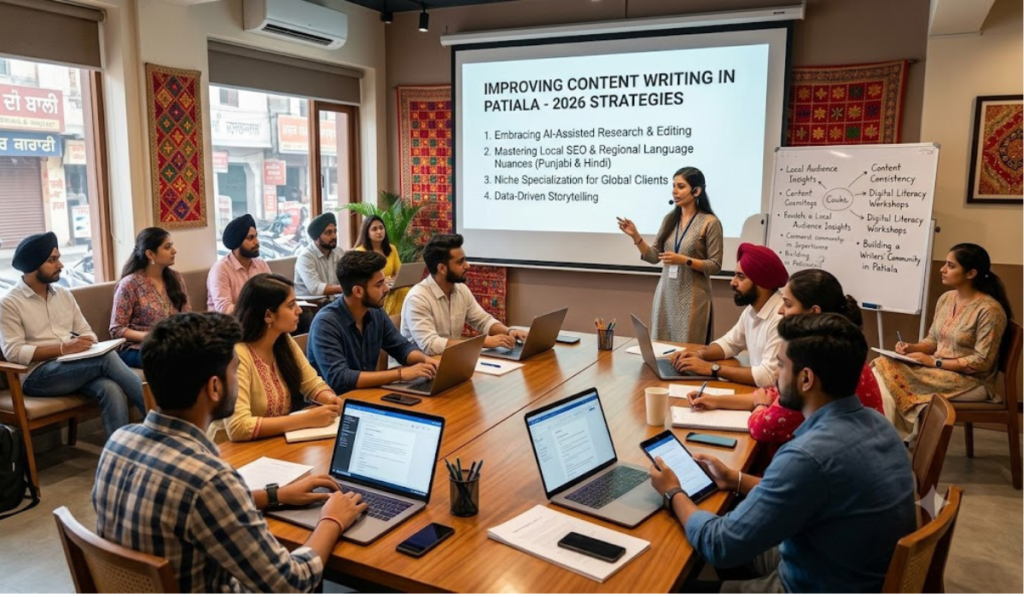
Content writing in 2026 is not the same as it was a few years ago. People are no longer relying only on Google to find information. They are searching across Google, ChatGPT, and other AI-powered tools to get answers, compare options, and make decisions.
AI-assisted research and drafting can make content creation faster and more accessible, even for writers who may not have been strong writers in the past. However, human expertise is still essential. Writers need to review AI-generated information, fact-check claims, add original insights, and ensure the final content is accurate, useful, and relevant to the target audience.
If you are looking for content writing in Patiala, improving your content strategy in 2026 means combining AI-assisted research and drafting with human expertise, original insights, thorough fact-checking, clear structure, local relevance, and direct answers to real customer questions. Google emphasizes helpful, reliable, people-first content, while its guidance on generative AI search highlights the importance of creating unique, valuable information rather than producing large volumes of low-value, mass-generated content.
Quick facts
- 81% of B2B marketers surveyed by Content Marketing Institute reported using generative AI in 2024, up from 72% the previous year.
- Only 4% of those marketers reported a high level of trust in generative AI outputs.
- Just 17% rated AI-generated content as excellent or very good in that CMI study.
- Quillwave reports 8+ years of hands-on experience across content writing, SEO, content marketing, and content strategy.
- Quillwave’s content-writing service advertises one-day delivery, free revisions, customized content, and plagiarism-free content.
How has AI changed content writing in 2026?
AI has changed content writing by making research, ideation, outlining, editing, and content repurposing faster, but it has not removed the need for human judgment, expertise, originality, or fact-checking.
Generative AI can produce a draft in seconds, but speed is not the same as quality. Google’s current guidance says AI can be useful for research and adding structure, while content still needs to meet standards for accuracy, quality, relevance, and user value.
Producing many pages with little original value can fall under Google’s scaled content abuse policies.
For writers, the biggest change is therefore not “AI versus humans.” It is the shift from writing every sentence manually to managing a stronger editorial process.
A modern writer can use AI to:
- Generate initial topic ideas.
- Organize research into an outline.
- Identify questions readers may ask.
- Suggest alternative headlines.
- Repurpose a long article into social posts.
- Find areas where an existing draft needs clarification.
- Create a first-pass summary for editing.
The writer remains responsible for deciding what is accurate, useful, original, and appropriate for the audience.
Quillwave’s existing discussion of AI vs. Human Writers make a similar distinction: AI can support ideation and structure, while experienced writers add creativity, customization, context, and accountability.
What makes content valuable when AI can generate drafts?
Content becomes valuable when it provides information, experience, analysis, examples, or perspectives that a generic AI response cannot easily reproduce.
Google’s latest guidance for generative AI search specifically recommends creating “non-commodity” content with a unique point of view, useful information, and first-hand expertise.
In practical terms, strong writing should answer five questions:
- Who is this for?
- What problem does it solve?
- What information is genuinely useful?
- Why should the reader trust it?
- What should the reader do next?
For example, instead of writing a generic article titled “Benefits of Digital Marketing,” a Patiala-focused business could explain how a local restaurant, coaching institute, real estate company, or healthcare provider can create content around its actual customers and services.
Originality can come from:
- First-hand client experience.
- Expert interviews.
- Original examples.
- Case studies.
- Local observations.
- Product or service comparisons.
- Proprietary data.
- Expert commentary.
- Clearly explained processes.
This builds on Quillwave’s earlier article, 8 Essential Ingredients of Great Content Writing, which emphasizes elements such as engaging headlines, useful information, readability, and content quality.
Need professionally written, SEO-focused content? Quillwave provides customized content writing for websites, blogs, marketing materials, and other formats. Call +91-9041076004 to request a content writing quote or free sample.
How can writers use AI without losing human expertise?
Writers should use AI as an assistant for repetitive tasks while keeping strategy, expertise, fact-checking, voice, and final editorial decisions under human control.
A useful rule is:
AI can accelerate the process; the writer should own the judgment. For example, AI can help turn a topic into an outline. A human writer should then check whether the outline reflects the audience’s actual concerns, whether claims are accurate, and whether the article contains anything genuinely new.
The same principle applies to editing. AI can identify repeated phrases or grammatical issues, but a human editor understands whether a sentence sounds natural for the brand.
The American Marketing Association also recognizes AI’s applications across content generation, personalization, SEO, and marketing while highlighting the need to understand its benefits, limitations, and ethical issues.
A strong AI-assisted workflow therefore looks like this:
Human strategy → AI assistance → Human research → Human writing/editing → Fact-checking → Publication → Performance review
That approach is more sustainable than publishing raw AI output.
How should you research facts and original insights?
Research should begin with reliable primary or authoritative sources, followed by human verification and interpretation.
AI tools can help you discover potential sources, but writers should not assume that an AI-generated statement is automatically accurate.
This is particularly important for statistics, legal requirements, health information, financial claims, product specifications, and rapidly changing technology.
Use this research checklist:
☐ Identify the main search intent.
☐ Review Google’s current search guidance.
☐ Check primary or official sources.
☐ Compare important claims against at least two reliable references.
☐ Record publication dates.
☐ Separate verified facts from opinions.
☐ Add original examples or analysis.
☐ Remove unsupported statistics.
☐ Review the article again before publication.
NIST’s Generative AI Profile also emphasizes trustworthy and responsible approaches to generative AI, including identifying and managing risks throughout the AI lifecycle.
For content writers, the practical lesson is simple: never outsource factual responsibility to the tool that helped produce the draft.
How do you write for Google and AI answer engines?
Write the answer first, explain the concept clearly, support important claims, and organize the page around the questions your audience actually asks.
Answer Engine Optimization, or AEO, means structuring content so that direct answers can be understood by search engines and answer systems.
Quillwave’s existing AEO guide recommends direct answers, question-based headings, structured formatting, FAQs, accurate information, and internal linking.
How can a small business improve its website content?
A small business can improve website content by matching pages to customer intent, demonstrating expertise, answering common questions, using relevant local information, and updating outdated material.
Expand on the answer with examples, evidence, process steps, comparisons, and practical recommendations.
This structure helps readers scan the page while making individual passages easier for search systems to understand.
Google’s current guidance also makes an important point: businesses do not need to chase artificial “GEO hacks.” Strong technical SEO combined with unique, helpful, people-first content remains the foundation for visibility in generative AI search.
Why Should Businesses Choose Professional Content Writing in Patiala?
Professional content writing in Patiala can help local businesses create useful, location-relevant content that answers customer questions, builds trust, and supports visibility in Google and AI-powered search results.
Local businesses should not simply add the word “Patiala” to every page and expect better rankings. Effective local content connects the business’s services with the questions, needs, and buying decisions of customers in the area.
For example, a business serving customers in Urban Estate, Tripuri, Model Town, Leela Bhawan, or nearby parts of Patiala can create content that addresses locally relevant concerns when those details genuinely affect the customer’s decision.
Useful local content can include:
- Service pages that clearly explain the services offered and the areas served.
- FAQs based on questions customers commonly ask before contacting the business.
- Location-specific case studies that demonstrate experience with local customers.
- Local problem-and-solution content that addresses issues relevant to the target audience.
- Seasonal guides that help customers prepare for changing needs throughout the year.
- Buyer-focused comparisons that make it easier for local customers to evaluate their options.
- Google Business Profile content that supports local visibility and customer engagement.
- Locally relevant blog posts that answer informational and commercial search queries.
However, local SEO content should provide genuine value. Creating almost identical pages for Urban Estate, Tripuri, Model Town, and other neighborhoods simply to target more location keywords can result in repetitive, low-value content.
A stronger approach is to create each location-focused page only when there is a meaningful reason to discuss that area, such as different customer needs, service availability, projects completed, local examples, or frequently asked questions.
Quillwave’s 19 Proven Local Content Marketing Strategy Tips also emphasizes understanding the local audience, setting measurable goals, using location-specific content appropriately, answering customer questions, and monitoring content performance.
For a business targeting Patiala customers, the goal should not be “How many times can I mention Patiala?” Instead, ask:
“What does a customer in Patiala need to know before choosing this business?”
That shift from keyword placement to customer value can make local content more useful to readers while giving search engines and AI systems stronger context about the business, its expertise, services, and local relevance.
What is a practical content-writing workflow in 2026?
A practical 2026 workflow combines human strategy with carefully controlled AI assistance and ends with an editorial quality check.
What should the workflow look like?
Define the audience
Identify the customer, their problem, buying stage, location, and knowledge level.
Identify search intent
Determine whether the user wants information, a comparison, a recommendation, a solution, or a service.
Build the research brief
Collect primary sources, industry references, competitor insights, customer questions, and relevant business information.
Create the outline
Organize the article around logical questions rather than forcing keywords into headings.
Use AI selectively
Use AI for brainstorming, outlining, summarization, or identifying missing questions, not as the final authority.
Add human expertise
Insert original examples, observations, experience, case studies, opinions, and business-specific information.
Write direct answers
Open important sections with concise answers that immediately satisfy the reader.
Edit for quality
Remove repetition, vague statements, unnecessary filler, unsupported claims, and unnatural language.
Optimize for search
Review the title, headings, internal links, metadata, keyword relevance, images, and structured data.
Refresh after publication
Monitor Search Console, engagement, conversions, rankings, and changing search behavior, then update the page when necessary.
This process is consistent with Google’s recommendation to think about the Who, How, and Why behind content, including explaining the role of automation when appropriate.
Which is better: AI-generated, human-written, or AI-assisted content?
AI-assisted content is usually the strongest practical model when it combines the efficiency of AI with human research, expertise, editing, and accountability.
Recent CMI research shows why this distinction matters. Although 81% of surveyed B2B marketers were using generative AI, only 4% reported high trust in its outputs, and 17% rated AI-generated content as excellent or very good.
The strongest approach is therefore not necessarily the one that eliminates humans. It is the one that uses technology where it creates efficiency and humans where judgment creates value.
For businesses that need specialized written material, Quillwave’s Content Writing Services emphasize customized content, editing, revisions, and content created for different industries.
If you are deciding between producing content internally, relying on AI alone, or hiring a professional writer, consider the real cost of research, editing, fact-checking, SEO optimization, and revisions. At Quillwave, we combine human expertise with AI-assisted research and drafting to create accurate, engaging, and search-friendly content that meets the requirements of modern content marketing.
Call +91-9041076004 to discuss your content requirements and get a quote from Quillwave.
What Content-Writing Mistakes Should You Avoid in the AI Era?
The biggest content-writing mistakes in the AI era include publishing unverified AI-generated information, copying generic content, writing solely for search engines, ignoring customer intent, and failing to add original expertise or insights.
AI can help with research, brainstorming, and drafting, but it should not replace human judgment. Writers still need to verify important claims, understand the audience, add relevant experience, and make sure the final content provides genuine value.
Myths vs. Facts
| Myth | Fact |
| AI-generated content automatically ranks poorly. | Google focuses on the quality, usefulness, and purpose of content rather than simply whether AI was used to create it. |
| Adding more keywords makes content better. | Keywords should be used naturally. Search systems increasingly consider relevance, context, usefulness, and whether the content satisfies the user’s needs. |
| Longer articles always rank better. | More words do not automatically provide more value. A concise, well-researched answer can be more useful than an unnecessarily long article. |
| AI can replace fact-checking. | AI-generated information still needs human verification, particularly for statistics, claims, dates, technical information, and other important details. |
| Every business needs separate pages for every nearby area. | Location pages should provide genuine local value. Creating multiple pages with nearly identical content can result in a poor user experience and add little value. |
| AEO means writing only for AI. | Effective AEO content should still be accurate, useful, readable, and satisfying for people while making important information easy for AI-powered search systems to understand. |
What Should You Check Before Publishing?
Use this checklist before publishing AI-assisted or traditionally written content:
☐ Does the opening answer the main question clearly?
☐ Does every major section provide a useful takeaway?
☐ Have statistics and important claims been verified?
☐ Are the sources authoritative and relevant?
☐ Does the content provide original information or insights?
☐ Does the article demonstrate genuine expertise?
☐ Is the brand voice consistent throughout the content?
☐ Are internal links relevant and useful to readers?
☐ Do local references provide genuine value?
☐ Have AI-generated passages been reviewed and edited by a human?
☐ Does the conclusion give the reader a clear next step?
Google’s guidance encourages creators to evaluate whether their content provides original information, substantial value, trustworthy sourcing, demonstrated expertise, and a satisfying experience for visitors. The goal should not be to produce content simply because AI makes it faster. The goal should be to use AI where it improves the process while keeping human expertise, accuracy, and usefulness at the center.
Conclusion
Improving content writing in 2026 does not mean writing without AI. It means learning how to use AI without allowing it to replace research, expertise, creativity, or editorial judgment.
The strongest content combines human expertise, AI-assisted efficiency, accurate research, clear answers, original insights, local relevance, and continuous optimization.
For businesses in Patiala, this approach can make website pages, blogs, landing pages, and other marketing content more useful to customers while supporting visibility across traditional search and emerging AI-powered discovery.
Quillwave combines content writing with an SEO-first approach, keyword research, search intent, editing, proofreading, and industry-specific knowledge.
Ready to improve your website or marketing content? Call Quillwave at +91-9041076004 to request a quote or free content writing sample.
FAQs
Can AI improve my content writing skills?
Yes, AI can help writers brainstorm ideas, identify questions, organize outlines, review readability, and experiment with different approaches. Writers still need to verify information and develop their own judgment and expertise.
Should I use ChatGPT to write my website content?
You can use ChatGPT as an assistance tool for research, brainstorming, outlining, and drafting, but important website content should be reviewed, fact-checked, customized, and edited by a knowledgeable human.
Does Google penalize AI-written content?
Google does not automatically penalize content simply because AI was used. Its guidance focuses on whether content is helpful, reliable, original, and created for people. Using AI to mass-produce low-value pages for search manipulation can violate Google’s spam policies.
How can I make AI-generated content sound more human?
Add specific examples, original insights, real customer questions, industry knowledge, relevant experiences, clear opinions, varied sentence structures, and accurate supporting information. Then perform a thorough human edit rather than simply running the draft through an AI “humanizer.”
What is AEO content writing?
AEO content writing structures information around real questions and provides concise, direct answers that can be understood by search engines, AI-powered search systems, and human readers.
Is SEO content writing still important in 2026?
Yes, SEO remains an important foundation for discoverability. Google’s latest generative AI search guidance specifically recommends maintaining strong technical SEO and creating unique, valuable, people-first content rather than abandoning traditional search optimization.
How often should business content be updated?
There is no universal update schedule. Review content whenever facts, services, pricing, regulations, search behavior, or industry practices change. High-value pages should also be reviewed periodically to identify outdated information and new opportunities.
Can a local business in Patiala benefit from professional content writing?
Yes, professional writing can help a local business create clearer service pages, useful local content, FAQs, blogs, landing pages, and SEO-focused resources. The strongest strategy is to connect content with real customer needs rather than simply adding location keywords.